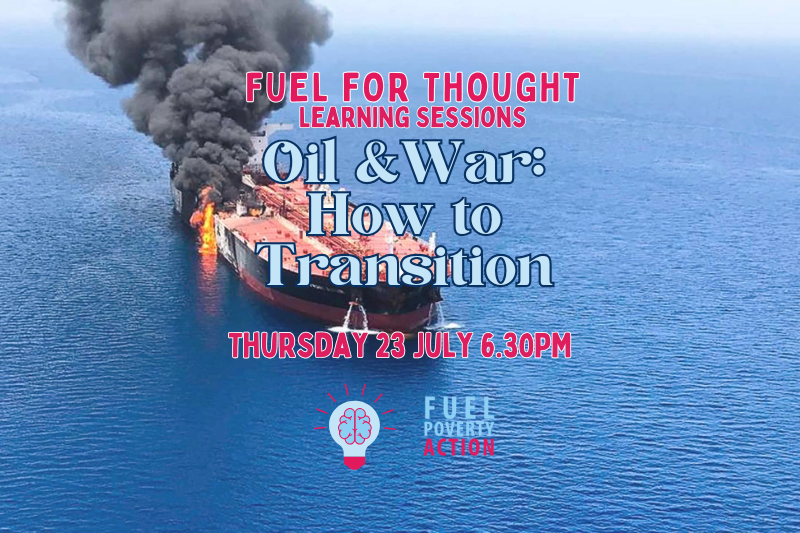
Fuel For Thought 26 Recap
by Amal Pouzoulet
Do you ever feel like history is repeating itself? As a direct result from the US-Israel war on Iran, our energy bills have risen again by over £200.
To add insult to injury, our ministry of war got £300bn after getting dragged into military involvement that’s killed thousands, destabilised the global economy, and driven up our bills.
Not only are we paying a premium for a war we didn’t ask for, we’re also paying forward for the next. In this Fuel For Thought we reflected on this pattern and how to break the cycle.
The session featured four speakers to introduce how the US-Israel war on Iran is impacting global energy prices and fuel poverty in the UK. While also examining the military-industrial complex’s reliance on fossil fuels and its role in driving climate change.
First, Kimia from Energy Embargo For Palestine presented on the significance of the Strait of Hormuz in the global economy and discussed the consequences of its closure due to US-Israeli war with Iran. She explained how the closure has led to the largest energy crisis in history, with global oil prices surging and causing fuel poverty in Britain, where energy bills have already risen as a direct result.
Counter to the conception that this oil crisis is driving a transition away from fossil fuels, Kimia discussed how new energy corridors for oil and gas are being developed to bypass the Strait. Moreover, she highlighted that renewable energy under current imperialist systems still relies on exploiting resources from the Global South. Concluding that true energy transition requires connecting struggles against fuel poverty, housing crises, and ecological collapse into a united front against imperialism.
The closure of the strait of Hormuz accelerated the drive for new East-West energy corridors.
Kimia – Energy Embargo For Palestine
Following this, we heard from Robert Palmer, Deputy Director at Uplift who discussed the UK’s transition away from fossil fuels, emphasizing the need for social and economic justice to be central to this transition. He highlighted how fossil fuel reliance drives higher energy bills, climate breakdown, and inequality, while energy companies pocket billions as the world burns.
Robert explained that solutions must include community and public ownership of renewable energy, support for fossil fuel industry workers in transitioning to new jobs, and, echoing Kimia, consideration of who owns green energy. Finally, he mentioned Uplift’s campaign against the Rosebank oil field for its significant carbon emissions and human rights concerns.
The UK’s reliance on oil and gas makes all of us poorer.
Robert Palmer – Uplift UK
Kirsten Bayes, local outreach coordinator for Campaign Against Arms Trade, presented a summary of the arms trade’s impact on climate change and international conflicts. She explained that the global arms trade is a $650 billion business, with British-made weaponry comprising $25-30 billion, and described how weapons sales are often linked to oil resources.
Kirsten highlighted that military activities have significant carbon impacts, with military equipment using 10 times more fuel than civilian alternatives and while militaries claim to have carbon neutrality targets, few are meeting them. Lastly, Kirsten discussed legal repression against activists opposing arms exports, citing the example of 25 young people facing prison sentences for attempting to stop arms exports from an Elbit factory in Filton.
The weapons industry is part of a system. You can simply call it “weapons for cash, or oil for cash for weapons.”
Kirsten Bayes – Campaign Against Arms Trade
Get Involved
Additonal Resources
- Greener Jobs Alliance September 2026 Newsletter – War and energy prices, with the Winter coming.
- Energy Embargo for Palestine // New Socialist
- Our Power Scotland
- Resisting Rearmament: A Unified Path Forwards for the British Left — Climate Vanguard
- Militaries failing on climate, says new in-depth study | SGR: Responsible Science
- To end fuel poverty, we must end imperialism – Prometheus Magazine
- Pipelines going West | Progressive International
- Martial Mining – The link between warfare and resource extraction
- The Climate Crisis and the US War Machine
- How Militarism Fuels The Climate Crisis — And Vice Versa | Lorah Steichen, Lindsay Koshgarian
- Trident, nuclear submarines and the UK’s nuclear power imperative
- Military interests are pushing new nuclear power – and the UK government has finally admitted it
- How the US helped create Iran’s nuclear programme
